Jonathan Slater, M.D., is a triple-board-certified psychiatrist — in Psychiatry, Child and Adolescent Psychiatry, and Psychosomatic Medicine — and a Clinical Professor of Psychiatry at Columbia University Irving Medical Center, where he is also a Senior Attending Psychiatrist on the Consultation Service at New York–Presbyterian Morgan Stanley Children's Hospital. He has run his own private practice since 1990.
Slater received his B.A. from Harvard University and his M.D. from Columbia University College of Physicians and Surgeons, where he completed his adult psychiatry residency, child and adolescent psychiatry fellowship, and a post-doctoral research fellowship in the pharmacological treatment of aggression. He earned a certification in psychoanalysis at the Columbia University Center for Psychoanalytic Training and Research. He served as Chief of Pediatric Psychiatry Consultation-Liaison and Attending for the Pediatric Cardiac Transplant Team at Columbia from 1992 to 2014, and directed the Pediatric Psychiatry Emergency Service from 2011 to 2014. He teaches narrative medicine to child psychiatry fellows, served on the Pediatric Bioethics Committee, and has been a preceptor in Columbia's medical school curriculum.
Slater's work with pediatric heart transplant patients led to two film projects. In 1992, he produced Second Chance: Heroes of Heart Transplantation in Children, a video used to prepare children and families for the transplant process. That work brought him to the attention of filmmakers Kirk Simon and Karen Goodman, and he served as medical consultant and liaison for their 1998 HBO documentary Heart of a Child, which took the experience of pediatric heart transplantation to a national audience.
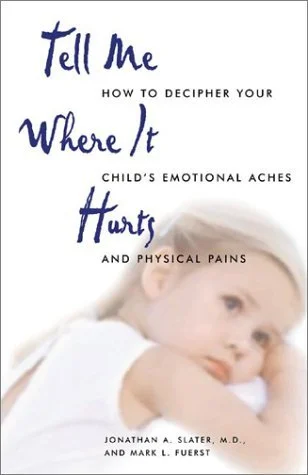
He is the co-author, with science writer Mark Fuerst, of Tell Me Where It Hurts: How to Decipher Your Child's Emotional Aches and Physical Pains (Adams Media, 2002), a book for parents on understanding the interface between physical symptoms and psychological distress — a question that has animated Slater's clinical work throughout his career.
A black-belt martial artist, Slater founded Once Upon a River in 2001, a program integrating karate, yoga, fitness, nutrition, and art therapy for children with psychiatric disorders, based in a dojo on the Hudson River in Irvington, New York. Over three years, the program served forty-four children aged six to fourteen, with more than half showing improvement across all eleven behavioral domains measured, and seven earning black belts.
Earlier in his practice, Slater was awarded one of three national research grants from the Big Apple Circus to study the Clown Care Unit, professional clowns deployed into pediatric hospital settings. He found that their presence measurably reduced children's procedural anxiety and made cardiac catheterizations run more smoothly. The research helped secure national expansion of the program and remains one of the few rigorous studies of humor as a clinical intervention.
Slater has written for the New York Times, the Washington Post, STAT News, MedPage Today, the New York Daily News, and Columbia Magazine. His op-ed “No, That AI Chatbot Is Not Your Friend” won a gold medal at the 2026 Digital Health Awards. Slater was interviewed on Here & Now, NPR’s national midday news program. He is a past participant in the Columbia Medical Journalism Workshop and now serves on its Academy Advisory Board. He publishes "Just the Facts," a Substack newsletter on child psychiatry aimed at making health and science evidence accessible to general readers. He is currently at work on a book of narrative nonfiction. He is a member of the American Psychiatric Association, the American Medical Association, and the American Academy of Child and Adolescent Psychiatry.
Selected Writing and Media
NBC News Now with Kate Snow, October 23, 2026 — Interview about my New York Times op-ed, “I’m a Child Psychiatrist. Screens Are Not the Problem.”
CJAD 800 Montreal, October 12, 2026 — Radio interview
New York Times, October 9, 2026 — I’m a Child Psychiatrist. Screens Are Not the Problem.
The Pulse, WHYY, August 13, 2026 — Guest expert, “Quitting Antidepressants: From Withdrawal to Tapering One Step at a Time.” Interview with Maiken Scott on antidepressant withdrawal, tapering, and access to mental-health care.
MedPage Today, June 22, 2026 — The Knicks Just Gave Us a Teaching Moment. Let’s Not Waste It. This historic win offers valuable lessons for young people’s mental health.
NPR, Here & Now, June 9, 2026 — Interview: RFK Jr. is pushing to wean Americans off SSRIs. A psychiatrist weighs in
STAT, May 13, 2026 — RFK Jr.’s antidepressant deprescribing push gets one thing right, and others dangerously wrong
Washington Post, April 28, 2026 — A measles crisis looms. Now is not the time to give up on vaccines.
MedPage Today, March 30, 2026 — What We’re Not Talking About: The War and Our Children
MedPage Today, October 24, 2025 — No, That AI Chatbot Is Not Your Friend. Gold Award winner, Spring 2026 Digital Health Awards.
MedPage Today, September 21, 2025 — School-Based Mental Health Screening Must Continue
MedPage Today, June 9, 2025 — The Self-Diagnosis Epidemic in Teens
NBC News Daily with Morgan Radford and Vicky Nguyen, May 9, 2025 — Young People Turning to Social Media to Self-Diagnose Mental Health Conditions
NBC News Daily with Kate Snow and Zinhle Essamuah, May 9, 2025 — Young People Self-Diagnosing from Social Media
Columbia Magazine, May 2024 — Legendary Child Psychiatrist Clarice Kestenbaum Looks Back and Forward
MedPage Today, March 4, 2024 — Teen Therapy and Psychiatry Online: Hit or Miss?
New York Daily News, July 31, 2022 — How ending Roe will hurt American teenagers
Talking Feds with Harry Litman, May 9, 2022 — 1-on-1 with Dr. Jonathan Slater: The Spike in Mental Health Issues for Children and Adolescents Under Covid
New York Daily News, April 10, 2022 — A generation on the brink: Kids and the world of COVID
New York Times, December 28, 2021 — Our Children Are Suffering. We Must Help Them.
New York Daily News, January 20, 2021 — The bigger virus is lack of trust
Book, October 2002 — Jonathan A. Slater, MD, and Mark Fuerst. Tell Me Where It Hurts: How to Decipher Your Child’s Emotional Aches and Physical Pains. Adams Media.
More writing lives on my Substack, Just the Facts.